Central Sea storm
A Journey to the Centre of the EarthThe Central Sea storm is the catastrophe that turns the raft expedition's outward voyage into a forced return. First announced by darkening clouds and a sudden change in the subterranean weather, it develops into days of wind, rain, lightning, and disorienting movement. The storm strips the raft of its mast and sail, carries the exhausted travelers an unknown distance, and ends with the craft wrecked on shore. Its consequences are not fully understood at once: only afterward does the travelers' compass help establish that the raft has been driven back to the coast from which it set out.
Gathering Weather and Conflicting Judgments
On Friday, August 21, the party is moving away from Henry's Island. The great geyser has disappeared from sight, and even its roar can no longer be heard. The weather changes with equal abruptness in prospect: vapor gathers above the saline waters, the clouds descend toward the sea and darken, and the atmosphere becomes heavy while the water remains comparatively calm. The narration presents these signs as an approaching confrontation between natural forces, not another struggle between animals.
The approaching storm also brings the travelers' judgments into conflict. The narrator proposes lowering the sail as a prudent precaution, but his uncle refuses: he would rather keep it raised in the hope that the raft might reach a visible coast, even at the risk of being swept away. That choice gives the storm's first blow a human context. The vessel is exposed not simply because the weather turns, but because the travelers continue to hope that forward motion may bring land into view.
The Tempest and the Raft's Destruction
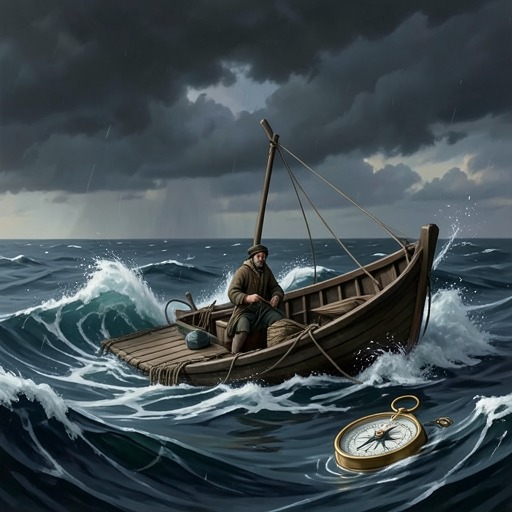
The southern horizon changes suddenly. Accumulated vapor turns to rain, and the air fills with a raging tempest that seems to come from every direction within the cavern. The raft rises and falls in the waves; the narrator struggles to reach his uncle, who clings to a cable. As the weather intensifies, rain and sea obscure the horizon they had been seeking. Lightning and thunder follow, and the narrator describes a storm whose force makes it difficult to see, hear, or hold on.
The surviving travel notes become incomplete during the worst of the violence. The account resumes with a dated entry for Sunday, August 23: the travelers are still being carried forward at great speed, unable to communicate over the thunder and repeated lightning. On Monday, August 24, the storm continues. The raft is running southeast, and the party has traveled two hundred leagues from the newly discovered island. Fatigue and exposure leave them with little control over their situation; they lash the cargo to the deck and secure one another against the waves.
A fireball then appears at the edge of the raft. The mast and sail are swept away, leaving the craft without the means of directing its course. The ball moves across the raft and reaches the provisions and powder barrel, adding immediate danger to the already damaged vessel. The travelers are left to endure the storm's force without a sail as the raft continues to be carried onward.
Duration, Disorientation, and Narrative Form
By Tuesday, August 25, the narrator has come out of a long fainting fit, but the storm is still raging and the raft is still moving at extraordinary speed. He speculates that they have passed beneath England, the Channel, France, and perhaps the whole of Europe. These are not measured positions; they register how far the travelers have lost their bearings. The sea offers no reliable horizon, and the speed and duration of the journey turn geographical knowledge into conjecture.
The form of the account preserves that disorientation. A journal records the voyage in dated fragments, but the narrator explicitly describes the notes as incomplete and vague at the height of the storm. When the narrative changes back from the journal to retrospective narration, he says that the journal was saved from the wreck. The surviving record therefore gives both a sequence of dates and a measure of what the ordeal has made difficult to remember or describe.
Shipwreck and the Reversed Route
The storm ends in a violent impact as the raft is cast onto a rocky shore. The narrator cannot later say exactly what happened at the moment of the wreck; he recalls being thrown into the waves and being pulled to safety by Hans, who carries him beyond their reach. The narrator eventually finds himself on sand with his uncle, the Professor. The survival of the journal and the survival of the travelers mark separate outcomes of the wreck: one preserves their account, while the other depends on Hans's intervention.
The direction of the voyage remains a question after the landing. When the narrator examines the compass, the needle returns consistently to the same unexpected point, and he finds no defect that explains its behavior. The instrument's reading, considered alongside the storm's sudden change of wind, leads to the unwelcome conclusion that the raft has been carried back to the shore they left days earlier. The storm thus reverses the expedition's apparent progress: the travelers have crossed a vast distance, but not in the direction they intended.
Consequences and Significance
The storm changes the voyage from an attempted crossing into an involuntary return. Before it arrives, the raft's movement away from Henry's Island suggests forward progress and the possibility of finding a coast. During the tempest, landmarks vanish, the vessel loses its mast and sail, and the travelers cannot reliably determine where they are. After the wreck, the compass supplies the evidence that their course has been reversed.
The episode also makes the cavern's weather an active force in the narrative. Vapor, wind, waves, and electrical phenomena successively alter what the travelers can see, hear, and do; the storm is not merely a backdrop to their decisions. At the same time, the difference between the narrator's dated but fragmentary journal and his later recognition of the return gives the reversal its shape: the storm's direction is concealed while it is happening and understood only after its consequences can be examined.